Ancelotti reflects on Brazil’s World Cup exit, outlines future plans

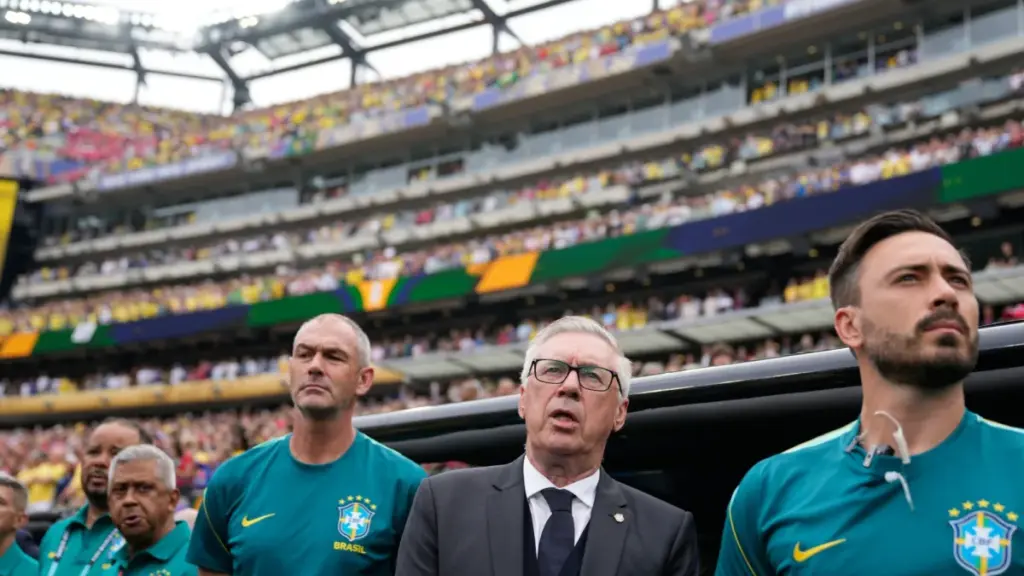
Ancelotti takes responsibility for World Cup loss
Brazil head coach Carlo Ancelotti has stated that a tactical decision made during the second-half hydration break in his side’s Round of 16 defeat to Norway was decisive in the team’s exit from the 2026 FIFA World Cup. Brazil was level at 0-0 when play paused for the mandatory cooling break. Following the break, the team conceded two goals to Erling Haaland, resulting in a 2-1 loss.
Ancelotti reflected on the defeat in an interview, taking responsibility for the tactical changes he implemented during the break. He explained that he believed Brazil had lost control of the match, a perception he now regrets. He made several changes to the team’s shape, which he believes led to the problem with Haaland’s goal. He also noted the difficulty of recovering in a World Cup match after conceding a goal late in the second half.
FIFA introduced mandatory three-minute hydration breaks midway through each half at the expanded 2026 World Cup. These breaks allow players to cool down and provide coaches with an opportunity to deliver tactical instructions. Despite Ancelotti’s admission, FIFA’s Chief of Global Football Development, Arsène Wenger, maintained during the tournament that these cooling breaks did not disrupt matches or influence results.
Brazil had opportunities to take control of the game before Norway’s late surge. Bruno Guimaraes had an early penalty saved, and substitute Endrick missed a one-on-one chance after the hour mark. Ancelotti, however, praised Norway, which reached the World Cup quarter-finals for the first time before losing to England.
Rebuilding and future vision
Following Brazil’s elimination from the World Cup, Ancelotti outlined his vision for the Canarinha over the coming years. The Italian coach, who will remain in charge until 2030 after declining an offer from the Italian federation, indicated that the defeat against the Scandinavians marks the end of one generation and the beginning of a rebuilding process focused on young talent.
Ancelotti addressed comparisons with Spain, the current world champion, acknowledging their success due to an exceptional generation of midfielders. However, he clarified that Brazil does not need to emulate Spain or France. Instead, he emphasized the importance of identifying specific areas for improvement, particularly in midfield, as he believes the team’s defense and attack are already well-structured.
The coach positioned the Los Angeles 2028 Olympic Games as a key component of his project. He highlighted that eight players from Spain’s Tokyo 2020 Olympic gold medal-winning team are now part of their world champion squad, whereas Brazil only brought two players from their Olympic team to the 2026 World Cup. This contrast reinforces his commitment to working closely with the Under-15, Under-17, and Under-20 categories, with players like Rayan, Endrick, Estêvão, and Vitor Reis already emerging. The 2028 Copa América is identified as the first major objective of this new cycle.
Emphasis on cohesive team model
Ancelotti also expressed a desire to move away from Brazil’s traditional reliance on a single star player. He advocates for a cohesive team model that prioritizes collective strength over individual prominence. He aims for a more vertical style of play for Brazil, utilizing the speed and game-changing abilities of players such as Vinícius Júnior, Endrick, Estêvão, and Raphinha.
In this renewal process, Neymar is not included, with Ancelotti confirming the end of his time with the senior national team. Ancelotti acknowledged Neymar’s professionalism despite an injury that affected his presence at the World Cup, explaining that his departure is a natural progression for a talented player concluding a cycle with the national team.
On a personal level, Ancelotti admitted that this elimination has been more challenging to process than other defeats he has experienced at club level, as an immediate opportunity for a rematch is not available. He stated that he feels fully supported by the Brazilian Football Confederation. The coach emphasized that his decision to remain in Brazil is driven by a genuine commitment to the project and the welcome he has received in the country, rather than contractual obligations, as he looks towards the horizon of 2030.
Source: vanguardngr.com

