Madugu apologises after Super Falcons miss Women’s World Cup qualification

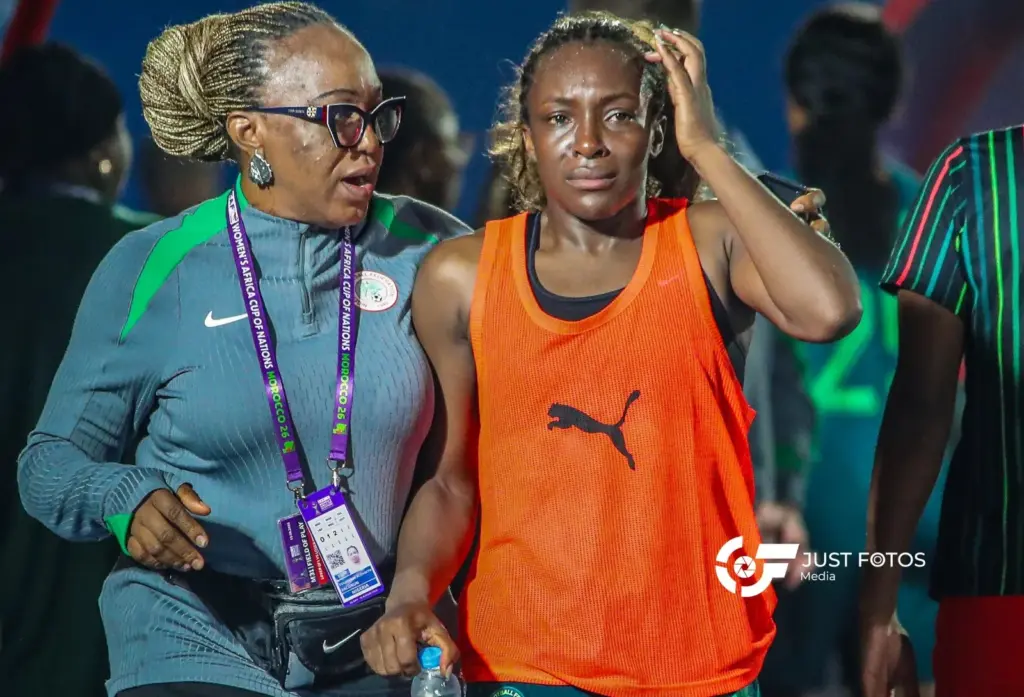
Super Falcons coach Justine Madugu has offered an apology following the team’s failure to qualify for the 2027 FIFA Women’s World Cup. Madugu attributed the outcome to defensive errors and a lack of clinical finishing, which contributed to their 2-1 loss against South Africa.
The defeat occurred in the Confederation of African Football (CAF) play-off, held during the 2026 Women’s Africa Cup of Nations in Morocco. This result signifies the end of Nigeria’s consistent participation in every edition of the Women’s World Cup since its inception.
Madugu expressed regret, stating, “I have to apologise to Nigerians over our inability to make it to the World Cup. We are very sorry. It was not our intention.” He acknowledged that despite their best efforts, it was not sufficient. “And we’re very sorry for that, and we take full responsibility for everything that happened. There can always be a next time. I’m sorry,” Madugu added.
Missed Opportunities and Defensive Lapses
The Super Falcons initially missed an automatic World Cup spot after a 1-0 quarter-final loss to Cameroon. They were then granted a second chance through the continental play-off. However, South Africa capitalised on Nigeria’s errors to secure their victory.
Thembi Kgatlana opened the scoring for South Africa in the 56th minute, followed by captain Refiloe Jane, who doubled their lead in the 77th minute. Nigeria managed to score a goal in stoppage time through Christy Ucheibe from a penalty kick, which was awarded after a VAR review and resulted in a red card for Jane.
Despite this late opportunity, Nigeria could not find an equaliser, allowing South Africa to advance to the intercontinental play-off tournament. Madugu admitted that the Super Falcons had numerous chances to alter the game’s outcome but failed to convert them.
“We had chances. Still, the conversion was another problem. And, uh, we made some little errors at the back. They capitalised on that, and, uh, they got the goals that they also got,” he explained. The coach specifically pointed to individual mistakes and poor decision-making as factors contributing to the goals conceded by Nigeria.
Madugu further elaborated on the team’s struggles, stating, “It is something that we really regret and feel very sorry about because it was more of individual errors in terms of decision-making that accounted for what actually happened.” He also highlighted a persistent goal-scoring issue.
“Of course, we will say we have a goal-scoring problem because we have not been clinical in front of the goal. We have not been clinical. We create several chances, but we are very wasteful with the opportunities that always come our way,” Madugu said. He believes that a more clinical approach would have resulted in more goals for the team.
According to the coach, the Super Falcons had enough opportunities in the first half to secure a comfortable lead against South Africa but were unable to convert them. “So, we have to blame ourselves for it. We have to blame ourselves for not taking the chances that keep coming our way. This was a game we would have finished in the first half based on the opportunities that we had, but we couldn’t utilise them,” Madugu stated.
He drew a contrast between the finishing abilities of the two teams, noting that South Africa was more effective when their chances arose. “In the second half, we still got chances. How many chances did South Africa get? But because they were more clinical, they converted the chances that came their way. Today, they are the ones who won the match.”
Historical Miss and Future Prospects
This defeat means the Super Falcons will miss the Women’s World Cup for the first time since the tournament began in 1991. Their journey to the World Cup had been reduced to these play-offs after their quarter-final loss to Cameroon in the 2026 Women’s Africa Cup of Nations. Only the semi-finalists from that tournament secured the four automatic tickets for African nations.
The four losing teams in the quarter-finals were given an alternative route to qualify through inter-confederational play-offs, aiming for one of the three non-automatic World Cup tickets. The Super Falcons were drawn against Banyana Banyana for a place in these inter-confederational play-offs, but they were unable to capitalise on this opportunity.
Meanwhile, South Africa has advanced to the first phase of the interconfederational play-offs for the World Cup, which is scheduled to take place in Brazil in June next year. This gives them another chance to secure their qualification for the 2027 FIFA Women’s World Cup.
The match was played at the Stade Moulay Rachid in Casablanca, Morocco, on Thursday.
Source: premiumtimesng.com

