WAFCON history and Nigeria’s dominance

WAFCON history and Nigeria’s dominance
The Women’s Africa Cup of Nations (WAFCON) has grown significantly since its beginning in 1991. What started with home-and-away qualification matches has evolved into a major sporting event on the continent, featuring players like Asisat Oshoala, Perpetua Nkwocha, and Barbra Banda. The tournament also serves as a qualification pathway for the FIFA Women’s World Cup.
Over the past three decades, the Super Falcons of Nigeria have established their dominance in African women’s football. When the Confederation of African Football (CAF) launched the Women’s African Championship in 1991, Nigeria defeated Cameroon to become the first women’s champions, securing qualification for the inaugural FIFA Women’s World Cup. Four years later, they successfully defended their title against South Africa.
The competition adopted a tournament format in 1998, with Nigeria hosting the finals. The Super Falcons won the inaugural tournament-style championship and continued to win every subsequent title until 2006, creating a notable dynasty in African sports. Legends such as Mercy Akide, Florence Omagbemi, Nkwocha, Rita Nwadike, Stella Mbachu, and Cynthia Uwak were key to Nigeria’s early success, later succeeded by stars like Oshoala, Desire Oparanozie, and Onome Ebi.
Emergence of new contenders
After nearly two decades of Nigerian dominance, Equatorial Guinea broke the monopoly in 2008. As the host nation, they defeated South Africa 2-1 in the final, becoming the first country other than Nigeria to win the continental title. This victory was a significant moment for women’s football in Africa, demonstrating that the Super Falcons were not invincible.
Equatorial Guinea further solidified their achievement in 2012 with a 4-0 victory over South Africa in the final, becoming only the second nation to lift the trophy. Despite later controversies regarding player eligibility, their victories remain part of WAFCON history and indicated growing competition across the continent. Nigeria responded by reclaiming the title in 2010 and continued their winning streak with further triumphs in 2014, 2016, and 2018.
The 2018 final in Ghana was a dramatic event, with Nigeria prevailing 4-3 in a penalty shootout against South Africa after a goalless draw, securing their 11th title. South Africa, having been runners-up five times, finally achieved their dream in 2022. Under coach Desiree Ellis, Banyana Banyana defeated hosts Morocco 2-1 in Rabat to win their first WAFCON title. This victory was seen as a reward for sustained investment in women’s football and highlighted the narrowing gap between traditional powerhouses and emerging teams.
Although Morocco lost in the 2022 final, their performance as hosts garnered attention. With significant investment from the Royal Moroccan Football Federation, Morocco has become a leading women’s football nation in Africa. Their consistent appearances in the later stages of major tournaments suggest increasing competitiveness in WAFCON.
| Year | Host | Champions | Runner-Up |
|---|---|---|---|
| 1998 | Nigeria | Nigeria | Ghana |
| 2000 | South Africa | Nigeria | South Africa |
| 2002 | Nigeria | Nigeria | Ghana |
| 2004 | South Africa | Nigeria | Cameroon |
| 2006 | Nigeria | Nigeria | Ghana |
| 2008 | Equatorial Guinea | Equatorial Guinea | South Africa |
| 2010 | South Africa | Nigeria | Equatorial Guinea |
| 2012 | Equatorial Guinea | Equatorial Guinea | South Africa |
| 2014 | Namibia | Nigeria | Cameroon |
| 2016 | Cameroon | Nigeria | Cameroon |
| 2018 | Ghana | Nigeria | South Africa |
| 2022 | Morocco | South Africa | Morocco |
| 2024 | Morocco | Nigeria | Morocco |
| 2026 | Morocco | — | — |
Historically, only three nations have lifted the WAFCON trophy: Nigeria with 10 titles, Equatorial Guinea with 2 titles, and South Africa with 1 title.
2026 tournament and title defense
The 2026 WAFCON officially begins on July 26 and runs until August 16 in Morocco, featuring 16 nations. These teams are competing for regional glory and a direct ticket to the 2027 FIFA Women’s World Cup in Brazil. Nigeria, holding the record for most titles, is in Group C alongside Zambia, Egypt, and tournament debutants Malawi.
Head coach Justin Madugu has assembled a balanced squad, combining experienced players with youthful talent. The team includes goalkeeper Chiamaka Nnadozie and captain Rasheedat Ajibade, with attacking options such as Asisat Oshoala, Chinwendu Ihezuo, Esther Okoronkwo, and Folashade Ijamilusi. The Super Falcons will open their title defense against Malawi.
A highly anticipated match will be against Zambia, who boast players like Barbra Banda and Racheal Kundananji. Zambia will be seeking revenge after a 5-0 defeat to Nigeria in the previous tournament’s quarter-finals. Nigeria will conclude their group phase against Egypt, a team looking to make an impact after missing the last edition.
Despite Nigeria’s historical dominance, Coach Madugu remains cautious, stating that every team now believes they can challenge Nigeria and that victories must be earned through discipline, hard work, and consistency. The Confederation of African Football (CAF) has increased the total prize fund to $5.8 million, with the champions set to receive $2 million. Every participating federation will receive a guaranteed $150,000.
The tournament is also a crucial qualifier for the 2027 World Cup. The four semi-finalists will secure automatic qualification, while the four losing quarter-finalists will compete for two additional spots in the intercontinental playoffs. Host nation Morocco, the 2022 runners-up, are considered strong contenders, along with South Africa and a resurgent Ghana squad. The top two teams from each group will advance to the knockout stage, which begins on August 8, leading to the final on August 16.
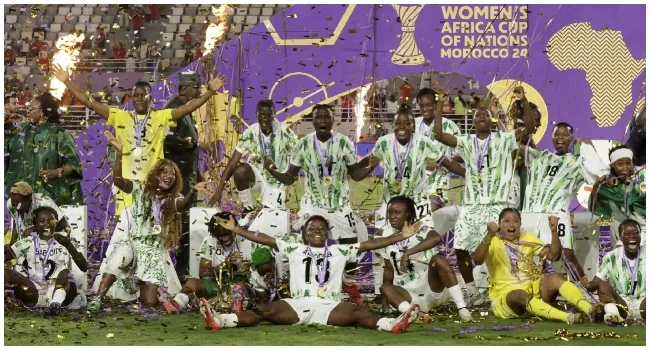
Super Falcons midfielder Toni Payne has expressed the team’s objective to retain their crown in Morocco. She noted that representing the Super Falcons comes with significant responsibility due to Nigeria’s strong reputation in African women’s football. Payne highlighted that the team’s identity as the “Giants of Africa” demands nothing less than another title-winning campaign.
Payne acknowledged the improved quality of women’s football across Africa, with nations like Morocco, South Africa, Zambia, and Ghana investing heavily in player development. The Super Falcons will begin their title defense against Malawi in Rabat.
Read Also
Source: channelstv.com

